MCP Agent Architecture – Global Orchestration Model
Overview
FacturaScan 360 is architected around a distributed system of intelligent MCP-compliant agents, each responsible for a distinct processing stage. These agents operate over well-defined semantic contexts (MCP), enabling loosely coupled AI services to interact via JSON-based structures, rather than tight procedural integration.
This document describes the agent topology, invocation strategy, lifecycle, and auditability mechanisms.
1. Agent Types and Responsibilities
| Agent Name | Input Context | Output Context | Responsibility |
|---|---|---|---|
ParserAgent | Textract JSON | InvoiceContext | Normalize OCR data into semantic fields |
ValidationAgent | InvoiceContext | ValidationContext | Apply rule-based semantic validations |
AnalyticsAgent | InvoiceContext | AnalyticsContext | Compute trends, flags, business insights |
ChatAgent | AnalyticsContext | Natural language | Generate conversational responses |
AlertAgent (future) | ValidationContext | Email / webhook | Trigger critical warnings |
ClassifierAgent (optional) | Raw or Parsed | Category, supplier type | Classify invoices for routing |
2. Execution Topology
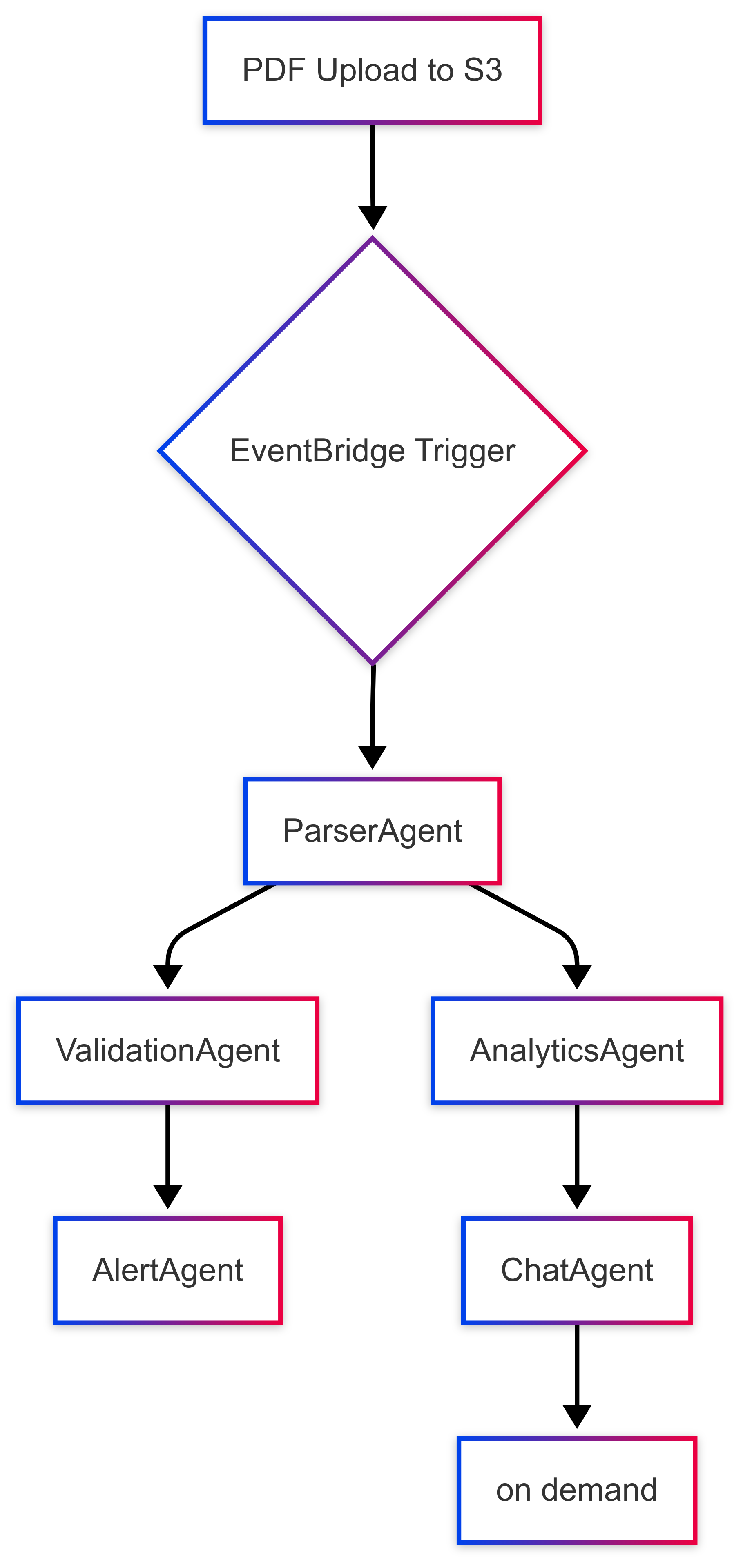
- Push-based orchestration via Step Functions
- Agents produce immutable MCP contexts persisted in database
- Chat agent operates pull-based, triggered by user query
3. Invocation and Isolation
| Mode | Description |
|---|---|
| Synchronous Lambda | Low-latency parsing or validation |
| Asynchronous (StepFn) | Decoupled, ordered flow (OCR → Validate → Analyze) |
| Manual API trigger | Agent can be retriggered via admin interface (idempotent) |
| ECS Microservices | Long-running agents with ML models or BI caches |
Each agent has its own deployment artifact, version, and log stream.
4. Agent Lifecycle and State
All agents follow the same logical lifecycle:
-
Receive input context (
InvoiceContext, etc.) -
Validate schema and MCP version compatibility
-
Execute logic (rules, ML inference, DB lookup, etc.)
-
Generate output context with metadata:
agent: name + versiontimestampinput_referencederived_fields
-
Store output context in
invoicestable (JSONB)
5. Failure and Retry Strategy
| Failure Type | Strategy |
|---|---|
| Schema mismatch | Log, reject, alert devops |
| Processing timeout | Retry up to 3 times (StepFn backoff) |
| Data dependency missing | Fallback to raw data (e.g., retry ParserAgent) |
| ChatAgent confidence < 0.5 | Prompt user for clarification |
All agent invocations are logged in agent_logs table.
6. Agent Logs Schema (for audit)
CREATE TABLE agent_logs (
    id UUID PRIMARY KEY,
    agent_name TEXT,
    agent_version TEXT,
    invoice_id UUID,
    input_context_type TEXT,
    output_context_type TEXT,
    success BOOLEAN,
    error_message TEXT,
    started_at TIMESTAMP,
    completed_at TIMESTAMP
);
7. Agent Scaling Strategy
| Agent | Scaling Model | Rationale |
|---|---|---|
| ParserAgent | Lambda or ECS burst | Depends on volume of OCR output |
| ValidationAgent | Stateless, parallelizable | CPU-bound, rules only |
| AnalyticsAgent | ECS or batch jobs | Requires access to invoice history |
| ChatAgent | On-demand via FastAPI | Used only upon user interaction |
| AlertAgent | Event-based Lambda | Low frequency, high priority |
8. Summary
FacturaScan 360’s AI architecture is designed around independently deployable, semantically aware agents that operate over structured contexts (InvoiceContext, ValidationContext, AnalyticsContext). This modular approach allows:
- Full traceability per agent and decision
- Scalable deployment across AWS services
- Conversational and programmatic access to intelligence
- Evolution of each agent independently via versioned logic
The MCP and agent orchestration together form the semantic backbone of the FacturaScan 360 intelligence layer.