Conversational Analytics Agent – MCP Integration
Overview
The Conversational Analytics Agent in FacturaScan 360 is designed to provide users with intelligent, context-aware answers to business queries over invoice data. It leverages the AnalyticsContext generated for each invoice, pre-aggregated insights, and semantic parsing to translate natural language questions into structured data operations.
This document defines the input-output behavior, internal logic, and architectural integration of the conversational layer with the MCP ecosystem.
1. Objective
To enable business users (accountants, CFOs, administrators) to ask questions in natural language such as:
- "Which supplier increased prices the most this quarter?"
- "Where do we spend the most money?"
- "What is our monthly average in telecommunications?"
- "Show me anomalies in invoices from the past 60 days."
2. Inputs and Dependencies
| Input Type | Source | Format |
|---|---|---|
| User question | Web dashboard chat UI / API | Free-text natural language |
| Invoice data | AnalyticsContext[] | JSONB entries from PostgreSQL |
| Validation flags | ValidationContext[] (optional) | For anomaly queries |
| Metadata | tenant_id, date range, user role | Contextual filter for queries |
3. Agent Pipeline
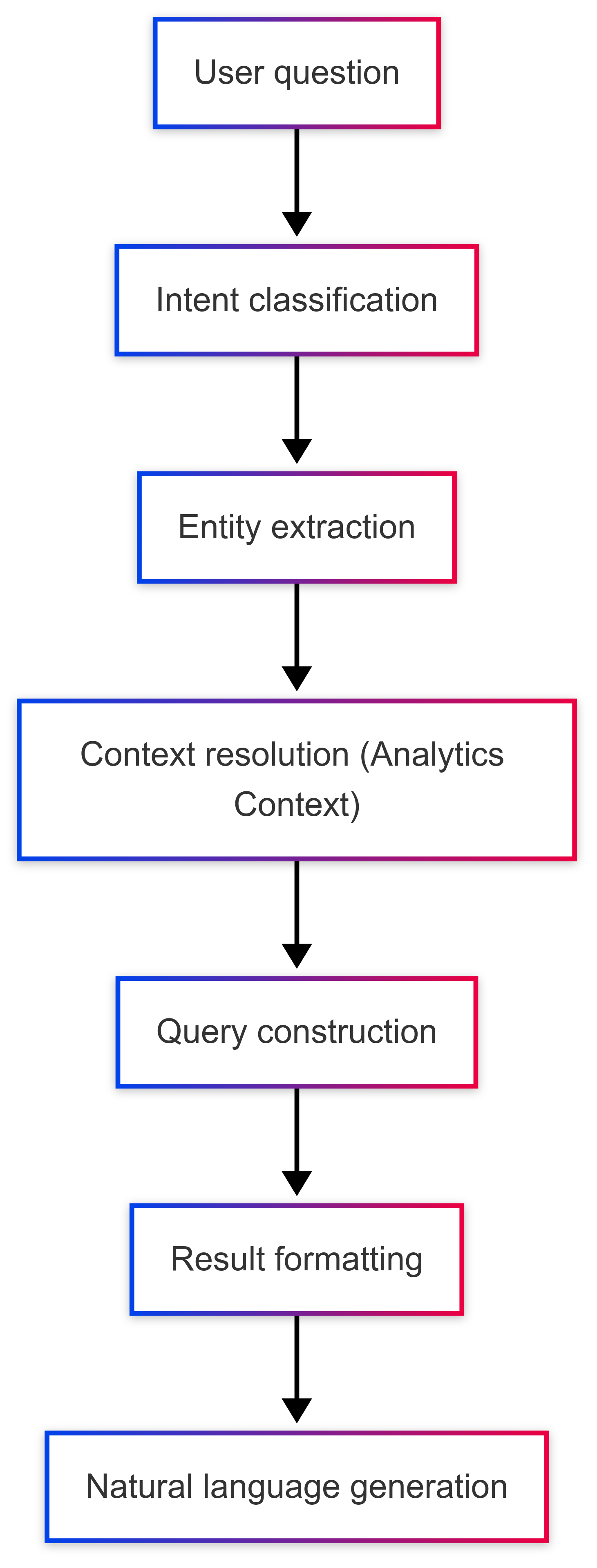
4. Supported Question Types (v1)
| Category | Sample Questions | Source Field |
|---|---|---|
| Supplier trends | "Who raised prices the most?" | price_variation |
| Expense overview | "Where do we spend the most?" | monthly_spend_avg, total_in_year |
| Categorized totals | "How much did we spend on software last year?" | supplier_category, total_in_year |
| Anomaly detection | "Show me invoices flagged as anomalies" | anomaly_flag |
| Time-based metrics | "Monthly spend in telecom over past 6 months" | monthly_spend_avg, timestamps |
5. Internal Logic
5.1. Intent Classification
Model trained to classify input into:
- Aggregation queries (sum, average)
- Ranking (max/min)
- Filtering (category, supplier, period)
- Anomaly detection
- Temporal trends
5.2. Entity Extraction
Entities identified:
- Suppliers (by name)
- Categories (e.g., “software”, “transport”)
- Time ranges (“this year”, “last 6 months”)
- Metrics (“spend”, “variation”)
5.3. Context Resolution
Queries are filtered by:
tenant_id- Predefined time range
AnalyticsContextversion compatibility
6. Sample Query Flow
User Input
"Which supplier increased their prices the most this year?"
Resolution
{
  "intent": "ranking",
  "entity": "supplier",
  "metric": "price_variation.12_month_trend",
  "filter": { "date_range": "last_12_months" }
}
SQL Behind
SELECT
  analytics_context->>'supplier_category' AS category,
  invoice_context->>'supplier_name' AS supplier,
  (analytics_context->'price_variation'->>'12_month_trend') AS trend,
  MAX(analytics_context->'price_variation'->>'compared_to_last_invoice') AS max_increase
FROM invoices
WHERE tenant_id = :tenant_id
  AND created_at > current_date - interval '12 months'
GROUP BY supplier, category, trend
ORDER BY max_increase DESC
LIMIT 1;
Agent Output (natural language)
“Supplier ACME Cloud Hosting shows the highest price increase over the past 12 months, with an average variation of +18.7%.”
7. Error Handling and Fallbacks
| Scenario | Agent Behavior |
|---|---|
| Ambiguous question | Prompt for clarification |
| No data in range | “No invoices found for this period.” |
Missing AnalyticsContext | Notify user of data still processing |
| Invalid supplier/category name | Suggest close matches |
8. Integration Pattern
- REST API endpoint:
POST /chat/query - Input:
{ "question": "...", "tenant_id": "..." } - Output:
{ "answer": "...", "sql": "...", "context": {...} } - Optionally log conversation in
chat_logstable for training
9. Future Roadmap
| Feature | Version Target |
|---|---|
| Multilingual support (ES/EN) | v1.1 |
| Drill-down interactive UI | v1.2 |
| Custom metrics via UI | v1.3 |
| Integration with BI agents | v2.0 |
10. Summary
The conversational analytics agent operationalizes AnalyticsContext into business-relevant, explainable insights. It enables clients to:
- Interrogate their invoice data directly via natural language.
- Receive structured, traceable responses.
- Derive immediate value from MCP-driven AI orchestration.