Model Context Protocol (MCP) – Design Specification
Overview
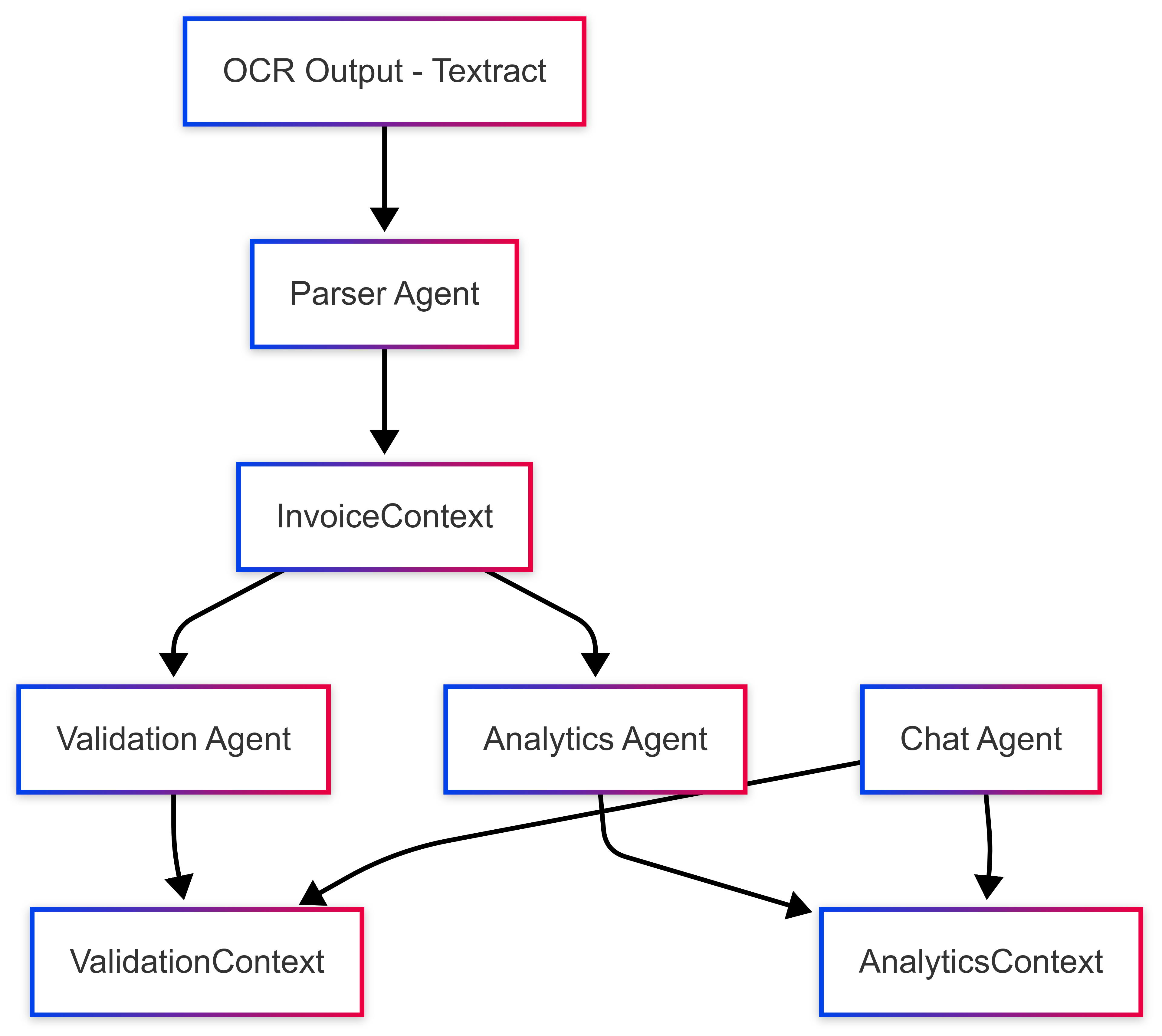
The Model Context Protocol (MCP) defines a set of semantic schemas for structured communication between AI agents within FacturaScan 360. Each MCP context represents a self-contained view of the system state, derived from one or more processing stages (OCR, parsing, validation, analytics) and used as inputs or outputs in agent interactions.
MCP ensures:
- Machine-readable, modular data exchange
- Traceability of agent reasoning
- Compatibility with JSON-based pipelines and conversational agents
- Decoupling between raw data sources and cognitive interfaces (e.g., chatbots)
1. MCP Design Philosophy
| Feature | Description |
|---|---|
| Contextualized | Each context includes only the necessary, enriched information |
| Declarative | Values are not procedural outputs but declarative facts for consumption |
| Composable | Contexts can be passed between agents or stored in database as-is |
| Extensible | Schemas support versioning and addition of new fields or agent scopes |
2. Agent Interaction Graph (Conceptual)
3. InvoiceContext Schema
Represents the semantic, normalized representation of a scanned invoice.
JSON Schema (v1.0)
{
  "invoice_id": "UUID",
  "tenant_id": "UUID",
  "supplier_name": "string",
  "supplier_tax_id": "string",
  "invoice_number": "string",
  "issue_date": "YYYY-MM-DD",
  "due_date": "YYYY-MM-DD",
  "currency": "string",
  "subtotal": "number",
  "vat": "number",
  "total": "number",
  "line_items": [
    {
      "description": "string",
      "unit_price": "number",
      "quantity": "number",
      "tax_rate": "number",
      "category": "string"
    }
  ],
  "payment_method": "string",
  "ocr_confidence": "float (0-1)",
  "source_pdf": "s3://.../file.pdf",
  "version": "1.0"
}
Usage
- Input to
ValidationAgentandAnalyticsAgent - Stored in
invoice_contextfield in theinvoicestable - Immutable once validated
4. ValidationContext Schema
Captures validation rules applied, their results, and agent decisions.
JSON Schema (v1.0)
{
  "invoice_id": "UUID",
  "agent": "ValidationAgent_v1.0",
  "validation_date": "timestamp",
  "rule_results": [
    {
      "rule_id": "V-01",
      "description": "VAT must be between 0 and 21%",
      "passed": false,
      "severity": "critical",
      "value_observed": 0.25,
      "suggestion": "Verify supplier or tax zone",
      "references": ["invoice_context.vat"]
    }
  ],
  "overall_status": "invalid",
  "notes": "Detected VAT anomaly",
  "version": "1.0"
}
Usage
- Consumed by alerting modules and chat/report agents
- Stored in
validation_contextin theinvoicestable - Cross-referenced with rules library (versioned)
5. AnalyticsContext Schema
Provides structured metrics and insights derived from the invoice, often for use in business intelligence or conversational querying.
JSON Schema (v1.0)
{
  "invoice_id": "UUID",
  "agent": "AnalyticsAgent_v1.0",
  "processed_at": "timestamp",
  "insights": {
    "supplier_category": "telecommunications",
    "total_in_year": 13850.25,
    "monthly_spend_avg": 1154.19,
    "anomaly_flag": false,
    "price_variation": {
      "compared_to_last_invoice": "+12.4%",
      "12_month_trend": "increasing"
    },
    "cost_center": "Operations"
  },
  "version": "1.0"
}
Usage
-
Input to Chat Agent for queries like:
- "Which supplier increased their prices the most?"
- "How much did we spend this quarter on office supplies?"
-
Also used in dashboards and reporting systems
6. Schema Versioning
All contexts include a version field. Schema evolution is handled as follows:
| Change Type | Action | Backward Compatibility |
|---|---|---|
| Add optional field | Minor version bump | ✅ Yes |
| Add required field | Major version bump | ❌ No |
| Change field type | Major version bump | ❌ No |
| Deprecate field | Minor version bump | ✅ Yes (with fallback) |
Version parsing and validation is handled by the AI agent orchestration layer.
7. Persistence in Database
| Context Field | Table | Column |
|---|---|---|
| InvoiceContext | invoices | invoice_context (JSONB) |
| ValidationContext | invoices | validation_context (JSONB) |
| AnalyticsContext | invoices | analytics_context (JSONB) |
These fields are indexed using PostgreSQL GIN indexes where required.
8. Security and Traceability
- All contexts are immutable after agent generation.
- Any regeneration (e.g., revalidation) results in a new row or versioned history (optional).
- Contexts are signed (or hashed) for audit traceability if legal assurance is needed.
9. Summary
The MCP structure supports scalable AI orchestration by:
- Encapsulating each phase of invoice understanding.
- Structuring internal data exchange between intelligent agents.
- Providing a unified schema for audit, analysis and conversational interfaces.
Next: see 07-conversational-agent.md for how queries like "Which supplier increased prices the most?" are processed using AnalyticsContext.